
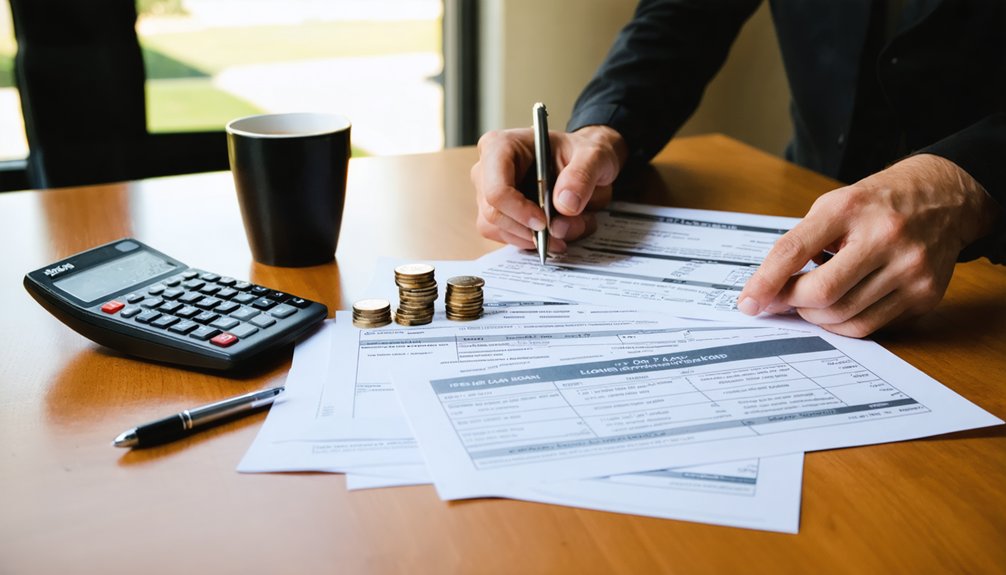

Interest rates shape personal loan costs by determining monthly payments, total interest, and whether borrowing beats alternatives like credit cards. Higher APRs raise installment amounts sharply; for example, a $10,000 three-year loan costs about $188 monthly at 8% versus $255 at 30%. Rates rise with Federal Reserve tightening, inflation, lender funding costs, and borrower risk factors such as credit score or debt-to-income ratio. Current offers range from roughly 6.25% to 36%, with more surrounding ahead.
What Raises Personal Loan Interest Rates?
Personal loan interest rates rise primarily when lenders’ funding costs and perceived lending risk increase. Federal Reserve moves on the federal funds rate shape banks’ borrowing expenses, and those pressures often filter into personal loan pricing after a delay. Because lower financing costs also make personal loans more appealing for consolidating revolving debt, borrowers often compare them against credit-card APRs that average 22.3%.
In January 2026, the Federal Open Market Committee held rates at 3.50-3.75% after three quarter-point cuts in 2025, showing how policy shifts guide lending conditions. Because the Fed signaled no major near-term decline, personal loan rates are likely to ease only gradually rather than fall sharply.
Inflation also pushes rates higher. When CPI and PPI run above the Fed’s 2-3% comfort range, policymakers typically tighten to protect purchasing power and cool borrowing.
Lenders likewise adjust for currency erosion, liquidity constraints, and regulatory capital limits. Secured loans backed by collateral typically qualify for lower interest rates than unsecured loans because they reduce lender risk.
Borrower-specific factors—credit score, debt-to-income ratio, employment stability, loan size, and loan‑duration impact—further affect pricing amid economic rate competition across capital markets nationwide.
How Rates Change Your Personal Loan Payment
Because interest is built directly into amortization, even small APR changes can materially alter a personal loan’s monthly payment and total repayment cost.
On a $10,000 loan over three years, 8% APR produces about $188 monthly, while 30% APR raises that figure to roughly $255, showing clear payment rate impact for households managing shared financial goals. Wells Fargo notes rates can be as low as 6.74% APR for loans of at least $10,000 with a 3-year term.
Fixed-rate personal loans preserve payment consistency, which helps borrowers plan with confidence across the full term. Comparing multiple rate and term combinations with a loan calculator can help identify the most budget-friendly option.
Yet payment elasticity still matters: extending repayment can lower monthly obligations while increasing cumulative interest. A longer term can reduce monthly payments but increase total interest.
For example, a $15,000 loan at 8% over 36 months requires about $456 monthly, versus $513 at 13.99%, with roughly $1,700 more interest.
Fees also raise effective cost, so meaningful comparison should include APR, term length, and origination charges before committing.
Why the Federal Funds Rate Matters
Rate shopping explains what a borrower pays, but the federal funds rate helps explain why new personal loan offers move in the first place. It shapes lender funding costs, and higher costs usually flow to consumers through prime rate fluctuations.
Banks commonly set prime about three percentage points above the federal funds rate, so benchmark changes influence pricing for newly originated loans. The Federal Reserve does not directly set personal loan rates, but Fed-driven benchmarks strongly influence how lenders price them.
Through rate transmission mechanisms, personal loan pricing often follows Fed moves with a lag, and the average loan rate generally remains above the funds rate while tracking its direction. Federal funds rate changes are typically announced in basis points, with 25 bps equal to 0.25 percentage points. Variable-rate loans may adjust within a month of a Fed cut, depending on lender terms.
This matters most for new borrowers and for variable-rate loans, which can reset within weeks under contract terms.
Current Personal Loan Rates in 2026
As of 2026 marketplace data, current borrowing costs show a clear spread by term length and credit quality: average APRs stand at 13.14% for 3-year personal loans and 17.33% for 5-year loans, with shorter terms consistently pricing lower across borrower tiers. On March 11, 2026, Bankrate’s benchmark put the average rate for a three-year personal loan at 12.26% based on a 700 FICO score, a $5,000 balance and a 36-month term.
Weekly movement remains modest, with 3-year rates down 0.06 points and 5-year rates down 0.30. Across the market, APRs range from 6.25% to 36%, while leading offers cluster lower: LightStream starts at 6.49%, Wells Fargo at 6.74%, Explore at 7.99%, and Citi at 9.99%. Borrowers with excellent credit often secure lower 3-year APRs, with 720+ scores commonly landing near 10%.
Commercial banks report a 12.06% average finance rate on 3-year loans, reinforcing broader loan term trends. For readers comparing national and regional loan options, single-digit APRs still define favorable conditions, especially as year-over-year averages have declined for both 3-year and 5-year products nationwide. In February 2026, a rate of 7.00% APR or less remained a strong good rate benchmark for borrowers with excellent credit.
How Credit Scores Change Personal Loan Rates
Credit scores sharply reshape personal loan pricing, often separating the lowest available offers from near‑ceiling APRs. Borrowers in the top credit tier, typically 720+ FICO, commonly see 3‑year APRs near 10% to 15%, while good‑credit applicants around 690 to 719 average 14.48%. By contrast, bad‑credit borrowers below 630 average 21.65%, and some lenders approach 36%. Since typical personal loan APRs range from 8% to 36%, the APR range widens the cost gap between strong and weak credit profiles. Lenders also weigh income and state eligibility, so even borrowers with similar scores can receive different offers based on underwriting factors.
This APR variance shows strong rate elasticity across score bands. Mid‑March 2026 data placed 720+ borrowers at 13.20% on 3‑year loans and 17.03% on 5‑year loans. Lender standards differ: Citi requires a 680 minimum and offers 9.99% to 17.49%, while LendingClub spans 6.53% to 35.99%. Credit unions also tend to offer lower APRs, with average three-year rates around 10.64% and caps near 18%. Beyond score effects, income, debt‑to‑income ratio, payment history, and credit age also shape offers for applicants seeking fair inclusion.
Personal Loan Rates vs. Credit Card APRs
Why do personal loans often cost less than revolving card debt over time?
Average personal loan APRs reach 12.26% for a 700 FICO borrower, versus roughly 20.97% for credit cards. Even among top-tier profiles, the gap persists: 11.81% for loans against 20.18% for cards. Fixed personal loan rates also stay constant, while most card APRs vary and promotional offers expire.
That difference materially changes costs members can plan around. On $5,000 repaid over 24 months, interest totals $629.22 with a personal loan versus $1,164.51 on a card. Fixed installments support budgeting and reduce minimum-payment drift. For loan consolidation, this structure often simplifies repayment.
Still, credit score impact matters: below 630, personal loan APRs average 21.65%, narrowing the advantage and requiring closer comparison before borrowing decisions.
When a Personal Loan Saves Money
Lower rates matter most when they change the total cost of a specific need. A personal loan can save money when it replaces higher-rate credit card balances, medical debt, or payday borrowing with one fixed payment.
With average credit card debt above $5,300 per holder, even modest rate differences can reduce total interest meaningfully and support stronger budget repayment timing across one due date.
Savings also appear when urgent expenses arrive. Fast funding for car repairs, medical bills, or essential home work can prevent revolving balances from growing.
Fixed rates create predictable payments, while loan term flexibility helps match repayment to household cash flow.
For large one-time costs, such as healthcare or home improvements, spreading expenses over structured installments may protect savings and strengthen financial stability for borrowers seeking control and confidence together.
How Rate Cuts Boost Refinancing Demand
Rate cuts typically make refinancing demand rise because even small declines in personal loan pricing can materially reduce monthly payments and total borrowing costs.
Because personal loan pricing generally tracks the federal funds rate, recent Federal Reserve easing has created a clear regional demand increase in borrower interest, although lender offers often adjust with a short delay.
Market data supports that pattern.
Hard inquiries for personal loans climbed 16% in 2025, signaling stronger refinancing consideration and a broader refinancing surge in applications and originations.
Lower rates also make replacing high-cost revolving balances with fixed-rate personal loans more attractive.
Recent quarter-point cuts, followed by the Federal Open Market Committee holding rates at 3.50% to 3.75% in January 2026, are expected to sustain refinancing demand through 2026, especially among well-qualified borrowers seeking measurable savings.
What Higher Rates Mean for Borrowers
Higher interest rates raise borrowing costs on two fronts: they increase monthly payments on new and refinanced personal loans and accelerate interest accumulation on existing variable-rate debt.
Even a 1% rate increase can materially raise installment costs and total interest paid over time, shrinking household cash flow for everyday priorities.
As rates climb, credit card balances become more burdensome, especially with average APRs above 22%, and discretionary spending often declines.
Budget pressure can delay renovations, travel, and appliance purchases while increasing default risk, particularly for borrowers with weaker credit or variable-rate obligations.
Lenders typically respond by tightening standards, reducing approvals and refinancing appeal.
In this environment, borrower education and loan term flexibility matter because they help households understand tradeoffs, compare obligations realistically, and stay connected to sound financial decisions and community-wide economic stability.
How to Lower Your Personal Loan Cost
Cost-saving strategies for personal loans are most effective when they target the two variables that drive total borrowing expense: interest rate and repayment time. Borrowers lower costs by paying extra toward principal, enrolling in autopay, using biweekly schedules, refinancing, and choosing shorter terms when cash flow allows.
Data shows the impact is measurable. Adding principal reduces the balance interest is charged on; even $50 extra monthly can cut payoff time by about 1.5 years. On a $30,000 loan at 18% APR, paying $1,000 instead of $762 saves $5,553 and trims 19 months. Autopay can reduce rates by 0.25% to 0.50% while preventing late fees. A disciplined budget payment plan, supported by seasonal budgeting, helps members sustain faster repayment and stronger financial stability long term.
References
- https://elevate-wealth.com/higher-interest-rates-affect-personal-finances/
- https://www.experian.com/blogs/ask-experian/personal-loan-usage-statistics/
- https://www.bankrate.com/loans/personal-loans/how-the-latest-fed-meeting-impacts-personal-loans/
- https://www.chase.com/personal/investments/learning-and-insights/article/how-interest-rates-can-impact-lending-strategies
- https://www.bankrate.com/loans/personal-loans/average-personal-loan-rates/
- https://www.lendingtree.com/personal/personal-loans-statistics/
- https://www.credible.com/personal-loan/personal-loan-interest-rates
- https://www.nerdwallet.com/personal-loans/learn/average-personal-loan-rates
- https://fred.stlouisfed.org/series/TERMCBPER24NS
- https://www.bankatfirst.com/personal/discover/flourish/why-are-interest-rates-rising.html